
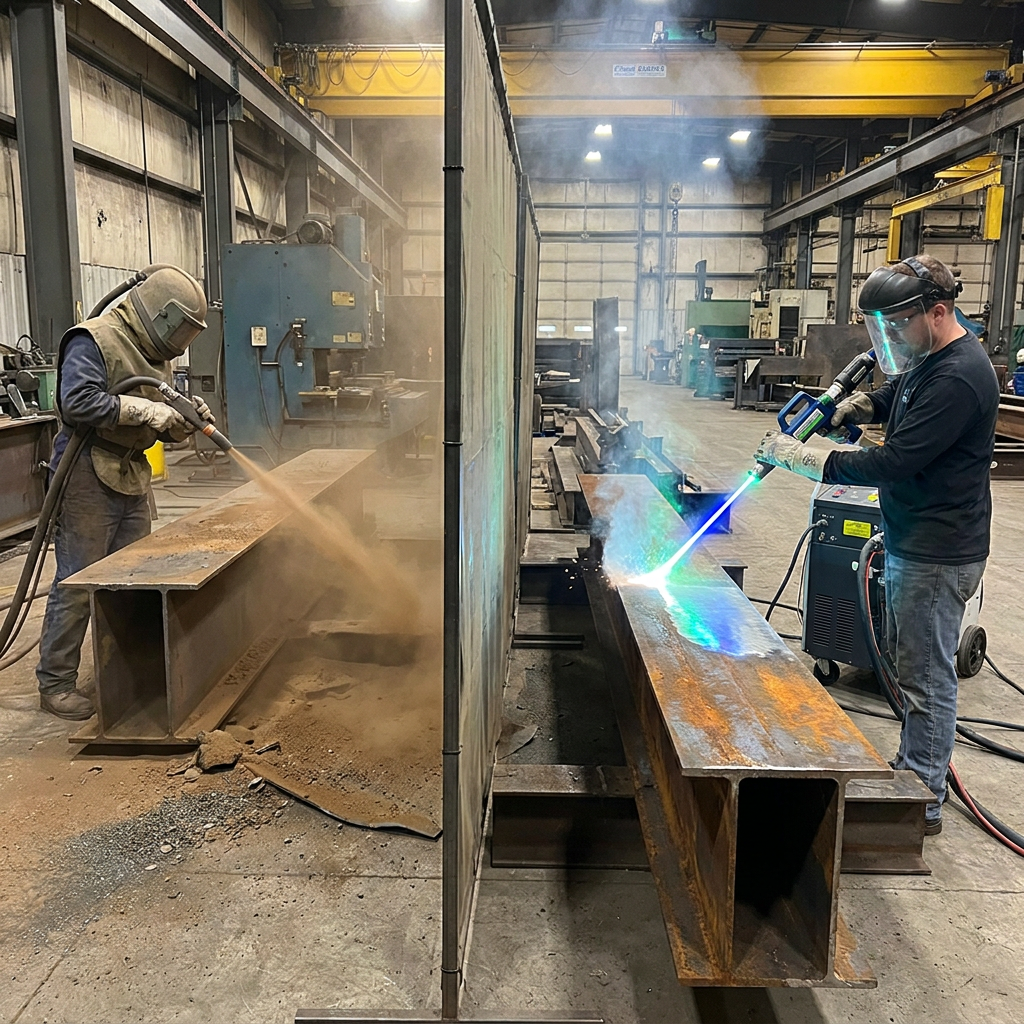
Surface preparation teams across Canada need to remove rust, paint, grease, soot, and oxidation without creating excessive waste in active production environments. Choosing an industrial laser cleaning system in Canada allows businesses to shift from abrasive impact cleaning toward controlled laser ablation.
Before replacing sandblasting, manufacturers should evaluate cleaning performance, safety controls, training requirements, and long-term operational support.
Why High Precision Manufacturers Choose an Industrial Laser Cleaning System
High-precision manufacturers increasingly use laser cleaning technology when surface condition directly affects weld quality, coating adhesion, or dimensional tolerances. Media-free ablation continues gaining attention because it removes contaminants without grit embedding, water carryover, chemical dwell time, or recurring blasting media. In many Canadian industrial facilities, condensation and environmental exposure can quickly lead to oxidation and recurring maintenance concerns.
Compared to traditional abrasive blasting, laser cleaning provides a more controlled process for sensitive surfaces and precision tooling. This approach is especially useful in applications involving moulds, fabricated components, and industrial restoration projects where substrate integrity matters. Surface decontamination applications across the aerospace, automotive, and industrial manufacturing sectors are driving the growing adoption of laser-based cleaning systems.
Evaluating Performance Metrics for an Industrial Laser Cleaning System
Performance evaluation should include the entire cleaning process rather than focusing only on beam speed. The greatest efficiency improvements often appear in operations slowed by masking, media recovery, ventilation cleanup, or disposal coordination. Cleaning speed can vary depending on coating thickness, substrate type, access limitations, and finish requirements.
Coating removal applications in industrial manufacturing and maintenance environments often benefit from the controlled nature of laser cleaning. Operators can gradually remove surface layers while reducing unnecessary substrate wear. Businesses considering implementation should also evaluate cooling setup, electrical compatibility, extraction systems, and operator controls before selecting equipment or services.
Comparing Industrial Laser Cleaning Services and In-House Hardware
Industrial laser cleaning services in GTA environments can provide a practical starting point for facilities with intermittent cleaning demands. Specialized service providers often supply trained operators, extraction systems, shielding equipment, and application support directly on-site. This can reduce implementation risk during the early stages of adoption.
In-house systems may provide stronger operational control for businesses handling recurring cleaning applications. Over time, facilities can experience operational cost savings by reducing blasting media purchases, disposal costs, cleanup labour, and maintenance downtime.
Operational Flexibility and Technical Support
Long-term return on investment depends heavily on utilization rates, contaminant variety, operator training, and maintenance planning. Some facilities benefit from dedicated in-house systems for repetitive cleaning tasks, while others prefer vendor-supported solutions for varying applications and schedules.
Titan Laser Inc. supports businesses through equipment rentals, machine sales, hands-on demonstrations, and ongoing technical guidance designed to simplify adoption.
Implementation Framework for Industrial Laser Cleaning System Adoption
Businesses transitioning from abrasive blasting should follow a structured implementation process to reduce operational risk and improve long-term performance.
- Identify contaminants, substrate conditions, and finish requirements.
- Review workspace limitations, ventilation requirements, and production constraints.
- Validate safety protocols, including controlled operating zones and the use of protective equipment.
- Conduct application testing on representative surfaces before deployment.
- Confirm maintenance responsibilities, training requirements, and operational benchmarks.
- Evaluate opportunities for automated integration where repeatable cleaning paths support production efficiency.
Automated integration continues to gain traction in manufacturing environments, where repeatable cleaning cycles improve consistency and reduce manual intervention. Safety protocols also remain essential when integrating laser systems into active industrial production settings.
Technical Training and Integration
Hands-on implementation training can significantly improve operator confidence and cleaning consistency. Facilities often benefit from live demonstrations that show how cleaning controls, positioning, and surface conditions affect performance outcomes. Training should also include extraction setup, protective equipment procedures, emergency controls, and daily maintenance practices.
Titan Laser Inc. helps businesses evaluate laser cleaning technology through application trials, implementation support, equipment selection guidance, and ongoing technical assistance.
Businesses seeking alternatives to abrasive blasting should evaluate how laser cleaning technology aligns with operational efficiency, environmental goals, and long-term maintenance planning. Contact Titan Laser Inc. to discuss industrial partnership opportunities, laser-cleaning implementation planning, equipment rentals, or long-term surface-preparation support.


