Laser Rust Removal in Canada: A Decision Guide to Machines, Rentals, and Services
Laser Rust Removal in Brief
Rust creates more than an appearance problem. It can interrupt production, complicate welding and coating, shorten equipment life, and turn routine maintenance into expensive rework. For Canadian businesses exposed to moisture, road salt, temperature swings, and demanding operating conditions, controlling corrosion is an ongoing requirement.
Laser rust removal offers a precise, non-contact way to remove oxidation without relying on abrasive media or chemical stripping agents. However, the technology is not a single solution for every facility. The right approach may involve purchasing a machine, renting one for a defined period, or hiring an experienced crew to complete the work on-site.
This guide explains how laser rust removal services work, how machine types and power levels differ, what affects equipment price, and how to choose between ownership, rental, and service. It also covers practical considerations such as throughput, portability, fume extraction, operator training, and workplace safety.
The main takeaway: wattage matters, but it should not drive the decision on its own. The most suitable option is the one that fits the material, corrosion level, cleaning frequency, work environment, and internal capacity of the operation.
Why Businesses Are Reconsidering Traditional Rust Removal
Rust removal has traditionally involved grinding, abrasive blasting, chemical stripping, or a combination of methods. Each can be effective, but each also adds work beyond the cleaning itself.
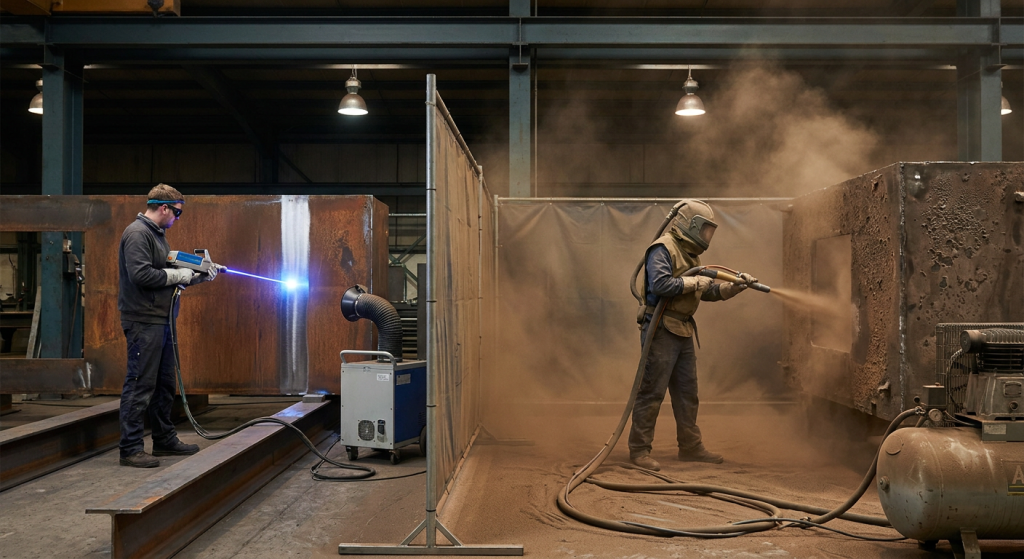
Abrasive blasting requires media, containment, cleanup, and disposal. Grinding can be slow and may alter the surface when too much material is removed. Chemical stripping introduces handling, ventilation, and waste-management requirements. These drawbacks become more significant when cleaning must be performed around sensitive equipment, on valuable components, or within an active facility.
Laser cleaning changes the process by using controlled light energy to remove the unwanted layer. It can reduce the need for consumables and limit the amount of secondary material left behind. It also gives operators more control over where cleaning occurs.
That does not make laser cleaning automatically faster or less expensive in every situation. Large, rough surfaces may still favour conventional blasting, while complex parts, selective cleaning, and repeat maintenance often play to the strengths of a laser system. A sound decision starts with the application, not with the technology alone.
What Is Laser Rust Removal?
Laser rust removal is a surface-cleaning process that uses focused laser energy to remove oxidation from a substrate. The laser is directed across the corroded area through a handheld cleaning head or an automated system. The rust layer absorbs energy, heats rapidly, and is released from the surface as vapour and fine particulate.
The base material reacts differently because it has different optical and thermal properties. With the correct settings, the system can remove the oxide layer while limiting heat input and unnecessary material loss. Results depend on power, pulse characteristics, scan pattern, travel speed, focal distance, and surface condition.
This is why laser cleaning is often described as selective rather than simply powerful. An operator can adjust the process to suit the material and the contaminant instead of applying the same mechanical force across the entire surface.
What the Process Can Reduce
Unlike abrasive cleaning, laser rust removal does not require a grit or sandblasting medium. It can therefore reduce:
Consumable purchases
Media storage and handling
Cleanup around the work area
Spent-media disposal
Abrasive residue on parts
Unintended wear on the substrate
The removed material does not disappear. Vapour and particulate must be captured through suitable extraction and filtration. Paints, coatings, oils, and contaminated corrosion products may also create specific hazards, so the material being removed should be assessed before work begins.
Where Laser Rust Removal Is Used
The process is used where controlled cleaning, surface preservation, or reduced cleanup is important. Common applications include:
Removing oxidation before welding, bonding, or coating
Cleaning fabrication equipment, tools, dies, and moulds
Maintaining structural steel and infrastructure assets
Treating localized corrosion on machinery and heavy equipment
Cleaning metalwork used in heritage and restoration projects
Laser cleaning can also remove paint, soot, grease, and other surface contaminants when the system and settings suit the task. Testing a representative area remains the most reliable way to confirm the finish and production rate.
Handheld systems connect a cleaning head to a laser source through a fibre-optic cable. They allow the operator to work around irregular parts, large machinery, vehicle frames, tanks, structural members, and installed equipment.
Portable does not always mean lightweight. Compact lower-power units may be easy to move between work areas, while higher-output machines may require a wheeled enclosure, more floor space, and a suitable electrical supply. Cable length, cleaning-head weight, and access around the part can matter as much as the size of the main unit.
Handheld systems are a practical fit for maintenance, field service, restoration, and varied shop work because the operator can bring the cleaning head to the surface.
Stationary and Automated Systems
Stationary or enclosed systems are designed for repeatable cleaning in a controlled area. They may be used for small parts, recurring production work, or integration with fixtures and automated handling.
These systems can offer more consistent cycle times where part geometry and contamination are predictable. They require planning around loading, extraction, guarding, and production flow, but may provide better control for facilities processing the same component repeatedly.
Pulsed and Continuous-Wave Lasers
Power alone does not describe how a machine performs. The way energy is delivered also matters.
Pulsed systems release energy in short bursts. This allows finer control over heat input and can make them suitable for precision cleaning, thinner components, sensitive surfaces, and work where surface preservation is a priority.
Continuous-wave systems deliver a steady beam. They are often considered for faster removal across larger areas or heavier contamination, although the added heat input must be managed carefully.
Neither technology is universally better. The material, coating or corrosion layer, desired finish, production rate, and tolerance for heat should determine which format is evaluated.
Comparing 200W, 300W, 500W, and 1000W Systems
Titan Laser Inc. offers machine options from 200W through 1000W. These power levels give businesses room to balance precision, portability, and throughput.
Demanding corrosion removal and high-volume industrial applications
Production speed and capacity
This comparison is a starting point, not a performance guarantee. Two surfaces with similar rust may clean differently because of material composition, geometry, coating history, or exposure conditions. Machine architecture and process settings also affect the result.
200W Laser Rust Removal Machines
A 200W system is often considered for controlled work on smaller areas. It may suit light surface oxidation, precision maintenance, tool cleaning, restoration, and applications where portability matters more than maximum coverage speed.
The lower power level can help an operator make measured passes and work around details. However, using a 200W machine on large areas of heavy corrosion may slow the job and require repeated passes.
300W Laser Rust Removal Machines
A 300W machine offers a step up in productivity while remaining suitable for varied maintenance work. It can be a useful middle ground for fabrication shops, contractors, and facilities that handle moderate rust, coating removal, and weld preparation across different parts.
For businesses without a single dominant application, this category may provide a practical balance between mobility and cleaning rate.
500W Laser Rust Removal Machines
A 500W system is better aligned with recurring industrial work, larger surfaces, or heavier corrosion. The additional output can improve coverage and reduce the time required for repeated maintenance tasks.
That productivity should be considered alongside electrical requirements, cooling, machine size, and operator handling. A faster cleaning rate only creates value when the surrounding workflow can support it.
1000W Laser Rust Removal Machines
A 1000W machine is intended for demanding applications where production capacity is a priority. It may suit large industrial surfaces, heavy corrosion, mill scale, and cleaning programs where reducing downtime has a measurable operational value.
Higher output also increases the importance of process development, extraction, guarding, and safety controls. A 1000W machine should be selected because the workload justifies it, not because it is the largest available option.
Key takeaway: too little power can slow production, while more power than the process needs can add cost and complexity. A sample test can reveal more than a wattage comparison alone.
When an On-Site Laser Rust Removal Service Makes Sense
Not every business needs to own or operate laser equipment. An on-site laser rust removal service can be the most practical route when the work is occasional, specialized, or difficult to move.
Service is worth considering when:
The project has a defined beginning and end
Rust removal occurs only during shutdowns or seasonal maintenance
The asset cannot be transported to a cleaning facility
The team does not yet have trained operators or a controlled laser work area
The business wants to test laser cleaning on actual parts before investing
Work is distributed across several locations within the provider’s service area
Using a service shifts equipment selection and operation to the provider. It also avoids purchasing a machine that may sit unused after the project.
The quote will usually depend on the surface area, corrosion severity, equipment required, site access, setup and containment needs, travel, and expected production rate. A supplier may request photographs or drawings at first, but an on-site assessment or sample test can produce a more reliable estimate.
The trade-off is availability. Service work must be scheduled, and repeated projects can eventually cost more than developing an in-house capability. If rust removal becomes a weekly part of operations, purchasing or long-term rental deserves closer analysis.
Titan Laser Inc. provides on-site laser cleaning in Ontario for applications that include rust, paint, grease, soot, and surface restoration. Machine sales can serve customers elsewhere in Canada, while rentals and on-site work remain focused on Ontario.
When Renting a Laser Rust Removal Machine Is the Better Fit
Rental sits between hiring a crew and purchasing equipment. It gives a business direct access to the machine without committing to ownership.
Rental can make sense for:
A maintenance shutdown with a fixed schedule
A large project that exceeds the capacity of existing equipment
Seasonal corrosion-control work
A contractor completing a project with a defined scope
A facility conducting an operational trial before purchase
A team that has trained operators but does not need year-round access
A trial should use real work rather than a simple demonstration. Record the area cleaned, time required, finish quality, extraction requirements, setup time, and operator feedback. This creates usable evidence for comparing rental, service, and ownership.
Before renting, confirm what is included. Training, cleaning heads, nozzles, extraction, safety eyewear, curtains, delivery, pickup, and technical support may be bundled or priced separately. Clarifying those details prevents a low headline rate from becoming a more expensive project once work begins.
What Affects Laser Rust Removal Machine Price?
There is no meaningful single answer to the question, “How much does a laser rust removal machine cost?” A useful quote must reflect the application and the full system required to operate it.
Power and Laser Technology
Higher-output systems generally cost more because they require a larger laser source, cooling capacity, electrical components, and supporting hardware. Pulsed and continuous-wave systems can also differ substantially in price and performance.
Duty Cycle and Cooling
A machine used intermittently for maintenance does not face the same demands as one expected to run through a production shift. Cooling design and rated duty cycle affect both price and long-term reliability.
Controls and Process Flexibility
Programmable scan patterns, saved cleaning profiles, adjustable pulse settings, and a clear operator interface can shorten setup and improve repeatability. Those features may increase purchase price but reduce trial and error during operation.
Portability and Ergonomics
Machine footprint, wheel design, cable length, cleaning-head weight, and power requirements influence how easily a unit can move through a facility or between sites. These details affect labour and usability even when they do not appear prominently on a specification sheet.
Safety Equipment and Extraction
The machine is only one part of the working system. A complete budget may need to include fume extraction, filtration, barriers or curtains, laser-rated eyewear, warning signs, access controls, and area modifications.
Certification, Warranty, Training, and Support
Buyers should ask for documentation that applies to the exact model being quoted. They should also compare warranty length, parts availability, operator training, technical support, and service response. Titan Laser Inc. offers hands-on training and legitimate certification status for the selected machine and configuration.
What Is Included in the Quote
Two quotes with the same wattage may cover very different packages. Before comparing totals, ask whether the price includes:
Cleaning head and standard accessories
Extraction and filtration equipment
Safety equipment
Delivery and commissioning
Operator training
Software and future updates
Warranty labour and replacement parts
Technical support after installation
The better question is not simply, “Which machine costs less?” It is, “Which complete system can perform the work safely, consistently, and at the required rate?”
How to Choose Between Buying, Renting, and Hiring a Service
The decision becomes clearer when it is tied to the way rust removal fits into the operation.
Frequency is often the strongest indicator. A machine used only a few times each year may not justify ownership once training, safety controls, maintenance, and storage are included. Regular weekly or daily use creates a stronger case for purchasing because the equipment replaces recurring service or rental costs.
Calculate the Full Cost of the Current Process
Comparisons should include more than the time spent cleaning. Account for:
Abrasive media or chemicals
Setup and containment
Labour during cleaning and cleanup
Waste collection and disposal
Equipment downtime
Rework caused by residue or surface damage
Outsourced service charges
Laser cleaning may have a higher upfront cost but a lower operating burden in applications with frequent cleaning and significant cleanup. In other cases, the current method may remain more economical.
Ownership is not only a cost decision. Immediate access matters when equipment must return to service quickly, or production cannot wait for an outside contractor.
Rental and service offer different forms of flexibility. Rental gives the internal team control over scheduling during the rental period. Service reduces the burden of operation and safety management. The best choice depends on which constraint matters most.
Is Laser Rust Removal Right for the Facility?
A practical evaluation should answer five questions.
1. What Material Is Being Cleaned?
Laser cleaning is commonly used on carbon steel, stainless steel, aluminum, and cast iron, but every substrate and finish responds differently. Thin sections, plated surfaces, precision dimensions, and heat-sensitive assemblies may require tighter process control.
When the part is valuable, or the material is uncertain, test a representative sample before approving the process.
2. What Must Be Removed?
Light oxidation, heavy rust, mill scale, paint, oil, and mixed contamination do not behave the same way. The layer thickness and composition affect the settings, cleaning rate, extraction needs, and number of passes.
Identifying the contaminant also helps determine whether the removed material may contain hazardous substances.
3. What Finish Is Required?
The goal may be visual restoration, weld preparation, coating adhesion, inspection, or removing a specific layer without disturbing the material below. Define the acceptance standard before testing the machine.
A clean-looking surface is not always the same as a surface ready for the next process. Where coating or bonding performance matters, confirm the required surface condition through the appropriate quality checks.
4. How Much Work Must Be Completed?
Estimate the surface area, frequency, available maintenance window, and acceptable downtime. A slower precision system may be ideal for small parts but unsuitable for a large structure. A high-output system may finish faster but require more setup and safety infrastructure.
5. Can the Facility Support Safe Operation?
Consider electrical service, floor space, ventilation, extraction, access control, reflective surfaces, operator training, and storage. Field work introduces further considerations, including public access, weather protection, and movement around the asset.
If several of these answers remain uncertain, begin with a sample test, demonstration, or on-site service. It is a lower-risk way to establish realistic cleaning rates and process requirements.
Why Laser Rust Removal Matters in Canadian Operations
Canadian equipment and infrastructure operate in conditions that can accelerate corrosion. Moisture, freeze-thaw cycles, industrial exposure, and de-icing salts all contribute to maintenance pressure. The cost appears in many forms: unplanned downtime, premature component replacement, added surface preparation, disposal fees, delayed coating work, and reduced asset life.
Rust removal alone does not solve corrosion. The broader program still needs inspection, root-cause control, protective coatings, suitable materials, and planned maintenance. However, a more controlled cleaning method can improve the way corrosion is addressed once it appears.
Laser cleaning can be especially valuable when the operation needs to:
Clean selected areas without blasting the entire component
Reduce abrasive media and chemical use
Limit cleanup around installed machinery
Prepare surfaces near sensitive features
Repeat the same cleaning task throughout a maintenance program
Preserve valuable parts that may be damaged by aggressive methods
The business case becomes stronger when the benefits affect production rather than appearance alone. Reduced cleanup, shorter outages, fewer consumables, and better control over the finish can all contribute to long-term value.
Why Work With Titan Laser Inc.?
Adopting laser cleaning involves more than choosing a power rating. Businesses need help matching the machine to the application, preparing the work area, training operators, and understanding what the process can realistically achieve.
Titan Laser Inc. supports three routes to adoption:
Machine sales across Canada for businesses building an in-house cleaning capability
Machine rentals in Ontario for trials, shutdowns, seasonal work, and short-term projects
On-site laser cleaning in Ontario for businesses that want the work completed by an experienced team
Available equipment ranges from 200W to 1000W, allowing recommendations to be based on precision, portability, corrosion severity, and throughput. Titan Laser Inc. also provides hands-on training and responsive support.
This flexibility matters because not every customer should begin with a purchase. A service visit or rental may be the better first step when the application is new, or the cleaning volume is uncertain. The goal is to establish a process that works in real operating conditions before making a larger commitment.
Making the Right Rust Removal Decision
Laser rust removal has moved beyond niche restoration work. It is now a practical option for Canadian manufacturers, fabricators, contractors, maintenance teams, and asset owners looking for greater control over corrosion removal.
The right path will not be the same for every operation. A one-time project may be best handled through an on-site service. A seasonal shutdown may justify a rental. A facility cleaning parts every week may gain more from purchasing a system and training an internal team.
The decision should be based on evidence from the actual application. Start with the material, contaminant, required finish, surface area, and cleaning frequency. Then compare total process cost, workplace readiness, and the value of having the equipment available when needed.
Titan Laser Inc. can help assess the application, compare 200W, 300W, 500W, and 1000W options, and determine whether a machine purchase, rental, or on-site service is the most practical fit.
Contact Titan Laser Inc. to discuss the project and request a recommendation based on the surface, corrosion level, workload, and operating environment.
A machine is purchased or rented and operated by the customer's team. It provides direct control over scheduling and can suit recurring work. With a service, a provider brings the equipment and completes the cleaning on-site. Service is often more practical for one-time projects, infrequent needs, or facilities without trained operators and a suitable laser work area.
Price depends on power, laser technology, duty cycle, cooling, controls, portability, accessories, certification, warranty, and support. A complete quote should also clarify whether training, extraction, safety equipment, delivery, and commissioning are included. Application details are needed before a useful price can be provided.
Laser cleaning can remove rust while limiting impact on the underlying metal when the system is correctly configured. Results depend on the substrate, contamination, power, pulse characteristics, travel speed, and operator technique. Testing is recommended for thin, coated, heat-sensitive, or high-value components.
Lower-power systems such as 200W and 300W are generally considered for light oxidation, smaller parts, and controlled cleaning. A 500W system can support heavier or more frequent industrial work, while 1000W equipment is aimed at demanding, high-throughput applications. A sample test is the most reliable way to match power to the required production rate and finish.
Yes. Rental can support short-term projects, shutdowns, seasonal work, and operational trials. It allows a business to measure cleaning rate, finish quality, setup, extraction needs, and operator experience before deciding whether to purchase.
It depends on the surface, corrosion level, power, and project scale. Laser cleaning can save time where targeted treatment and reduced cleanup matter. Abrasive blasting may remain faster on some very large or heavily corroded surfaces. The full comparison should include setup, containment, cleanup, disposal, and any rework, not cleaning speed alone.
It avoids spent abrasive media and chemical stripping waste, but it still produces vapour and fine particulate from the material being removed. Suitable extraction and filtration are required, and the hazards associated with rust, paint, coatings, or other contaminants should be assessed before cleaning.
Yes. Operators need machine-specific instruction and laser safety training. Class 3B and Class 4 systems require a structured safety program with appropriate controls, restricted access, eye protection, ventilation or extraction, and assigned responsibility for laser safety.
Titan Laser Inc. sells and ships laser cleaning machines across Canada. Machine rentals and on-site laser cleaning services are available within Ontario. Availability, travel, and scheduling should be confirmed for the specific location and project.