How to Compare Laser Cleaning Machines: A Buyer’s Guide
Summary
To compare laser cleaning machines, define the work first: the contaminant, the base material, the size of the area, and how often the job repeats. Then match power, format, and ownership model to that work. Wattage matters, but it should not lead the decision on its own.
Compare machine settings, portability, and performance on a representative sample before selecting a system. Assess whether portable equipment or a dedicated cleaning station suits your workflow.
Buying fits recurring work, and Titan Laser Inc. ships machines across Canada. Rentals fit short projects and trials, while on site services fit occasional jobs; both are available in Ontario only. Request documentation for the selected machine and review workplace safety requirements before purchase.
Laser cleaning is still new to many maintenance and production teams. Teams familiar with traditional cleaning methods may need guidance when comparing laser equipment. A laser system, by contrast, arrives with a spec sheet full of terms that do not map neatly onto anything they already use.
That gap creates risk. A team might choose a machine on wattage alone and discover it is too heavy for the sites it needs to reach. Another might buy a compact unit for thick coatings and spend far longer on each part than planned. Either way, the investment underdelivers, and the technology takes the blame.
If you are reviewing a laser cleaning machine for sale, this guide gives you a structured way to compare options. It explains how the technology works, how machine specifications and operating settings affect selection, and how portable and workshop formats differ. It also covers which contaminants each class handles, when buying makes more sense than renting or outsourcing, and which product documents to request before purchase. The last section lists the questions to ask before you place an order.
How Laser Cleaning Technology Works
Laser cleaning removes surface contaminants with short, focused pulses of light. The contaminant layer absorbs the laser energy, heats rapidly, and vaporizes or breaks away. Assess the substrate after testing to check whether the selected settings affect its condition.
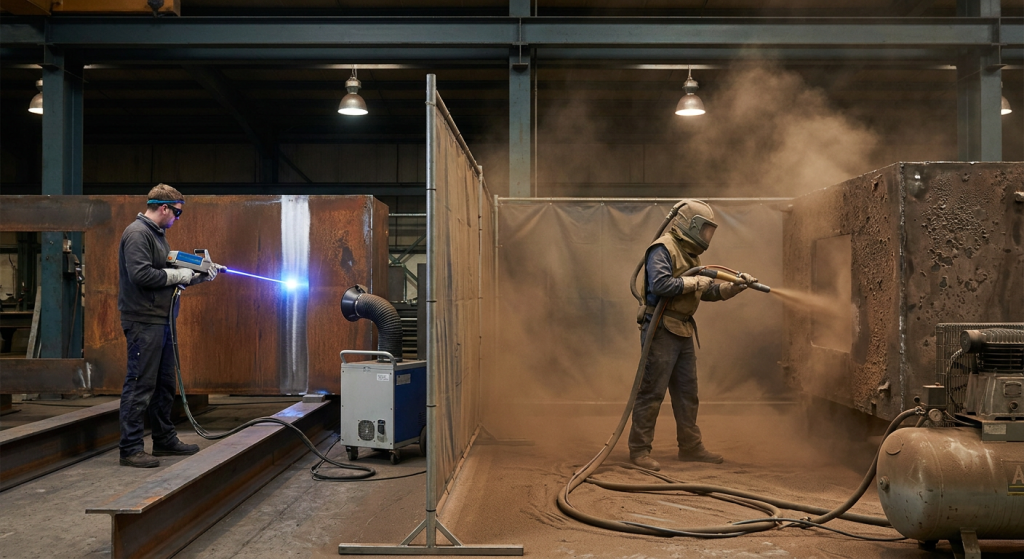
The process does not touch the surface. There is no grit, no blasting media, and no chemical bath. The operator guides a handheld cleaning head across the part, much like spraying paint, and the beam scans a narrow strip as it moves.
What Happens at the Surface
Every material reacts to light differently. Rust, paint, grease, and soot absorb laser energy readily. Bright, clean metal reflects more of it. That difference is what makes selective removal possible.
As the beam passes, the contaminant layer lifts away. Monitor the surface during testing and assess the result before continuing. The operator can see the change in real time and adjust speed or settings as needed.
This is also why laser cleaning works well for weld preparation and coating preparation. Check the cleaned surface against the requirements of the next process.
What the Operator Controls
A laser cleaning machine gives the operator several levers:
Power output, set by the machine class
Pulse settings, which affect how aggressively the layer is removed
Scan width, or how wide a strip the beam covers on each pass
Travel speed, or how quickly the operator moves the cleaning head
Getting these right is a skill. Operators need training for the selected machine and application. That is why hands on training matters as much as the hardware itself.
Common Misconceptions
Laser cleaning is a strong alternative to traditional methods, but it is not magic. A few points are worth stating plainly:
It still needs fume extraction. Vaporized contaminants must be captured, not released into the workspace.
It still needs laser safety controls, including eye protection and a defined work zone.
It removes contaminants. It does not restore metal that corrosion has already eaten away.
It is not automatically faster than blasting on every job. Thick, heavy coatings over large areas still need careful planning and the right power class.
The practical advantages are real, though. No abrasive media means no spent grit to collect and dispose of. Selective control means operators can clean one area without disturbing the next. Compare cleanup requirements and surface acceptance criteria during application testing. The article on replacing sandblasting with laser cleaning machines covers this comparison in more depth.
Compare Machine Specifications and Settings
Power rating tells you how much laser energy a machine can deliver, and that shapes how quickly it removes a given layer. Wattage matters, but it should not drive the decision on its own. Compare power alongside pulse settings, beam characteristics, and results on representative material. On light contamination or sensitive parts, extra power can add cost and weight without adding much value.
Ask Titan Laser Inc. which machine options suit your application.
Portability and Access
Check machine weight, dimensions, and handling requirements before planning transport. Consider who will move the machine, how often, and over what ground. A machine that cannot reach the asset delivers no value on that job.
Cleaning Settings
Settings shape results as much as the machine itself. Pulse settings, scan width, and travel speed all affect how quickly and how gently a layer comes off. Ask the supplier to explain the beam characteristics of the proposed machine. Ask how operators learn to adjust settings for different materials.
Application Testing
Bring a sample that carries your typical contaminant on your usual substrate. Watch how the layer comes off, check the surface afterwards, and note how long the area took. Those observations give you a fair basis for comparing machines. For a structured way to score those results, see this guide to comparing laser cleaning machines for industrial applications.
What Power Does Not Tell You
A spec sheet wattage figure leaves several questions open. Two machines with similar ratings can still differ in beam quality, cleaning head design, cooling, and ease of use. Ask how the system behaves on your actual material, not just what it can deliver at full output. A sample test on a representative part answers that question faster than any brochure.
Compare Portable Units and Workshop Systems
The format question comes down to one thing: does the machine go to the work, or does the work come to the machine? Portable units travel to the asset. Workshop systems stay in one place and process the parts brought to them. Most buyers know the answer once they map where their cleaning actually happens.
When Portable Units Make Sense
Portable laser cleaners suit teams that clean installed equipment, structures, or assets spread across a site. Compare transport requirements against site access, available handling equipment, and the proposed machine’s specifications.
Portable formats tend to work well for:
Maintenance crews cleaning equipment in place during shutdowns
Contractors moving between client sites
Restoration work on structures, masonry, or large assets that cannot move
Facilities with cleaning needs in several buildings or bays
The trade off is setup time. Each move means transport, power connection, and extraction at the new location.
When a Workshop System Makes Sense
Assess whether a dedicated cleaning station suits your workflow, access requirements, and extraction arrangements. Fabrication shops, refurbishment lines, and repair facilities often bring parts to a dedicated cleaning area.
Assess access controls, extraction, and other safety requirements for the proposed cleaning station. You can set up a defined laser work zone, permanent fume extraction, and controlled access once. Every job then runs inside that setup.
The trade off is reach. A fixed station only serves parts that can travel to it.
Practical Factors Beyond the Format Label
Before choosing, check the details that affect daily use:
Confirm the power supply at each site matches the machine’s electrical requirements.
Compare dimensions and weight on the product pages with your doorways, vehicles, and lifts.
Plan fume extraction for both site work and shop work.
Decide who moves the unit and how it is protected between jobs.
The full range of laser cleaning machines includes both portable and larger formats. Assess whether your work requires portable equipment, a dedicated station, or both.
Match Machine Power to Your Workload
Matching power to workload means sizing the machine for the work you do most often, not the hardest job you face occasionally. Oversizing ties up capital in capacity that sits unused. Undersizing stretches every job and frustrates operators. The goal is a machine that handles the routine comfortably and the occasional heavy task acceptably.
Questions That Define Your Workload
Start by describing the work in plain terms:
How thick and stubborn is the typical layer? Light surface rust and oil behave very differently from mill scale or multi coat epoxy.
How large is the typical area? A weld seam and a structural beam need different approaches.
How often does the work repeat? Daily production cleaning is a different case from a quarterly shutdown.
How sensitive is the base material? Thin sheet, tooling, and heritage surfaces need finer control.
Assess Your Application
Use this table to describe your application before you talk to suppliers. Final fit depends on a test on representative material.
Factor
What to assess
Why it matters
Contaminant
Type, thickness, and how firmly it bonds
Shapes the settings and the time each area takes
Substrate
Material, thickness, and finish
Sets how gently the layer must come off
Area and volume
Size of typical parts or assets and how often the work repeats
Guides the machine choice and the ownership model
Location
Where the work happens and how the machine will reach it
Decides between portable use and a fixed station
Safety and extraction
Work zone, eyewear, and fume capture
Must be in place before any cleaning starts
Testing
Results on a representative sample
Helps assess suitability before purchase
Common Sizing Mistakes
A few mistakes come up again and again:
Buying for the worst case. Assess occasional demanding tasks separately when comparing purchase, rental, and service options.
Ignoring mobility. A powerful machine that cannot reach the asset delivers no value on that job.
Skipping the test. Teams that size from a spec sheet alone often misjudge how long real parts take.
Forgetting operator time. A faster machine only saves labour if operators are trained to use it well.
The Cost of Getting It Wrong
A poorly matched machine does more than slow one job. Rework becomes routine. Coating schedules slip. Teams drift back to blasting or grinding for the hard jobs, and the laser sits in a corner. Meanwhile, corrosion keeps spreading on assets that were due for attention.
Ask the supplier to assess the contaminant and substrate before recommending a machine. The useful question is not “can it remove paint?” but “how well does it remove this paint, on this surface, at this volume?”
Contaminants Laser Cleaning Removes
Laser cleaning is used across a wide range of industrial and restoration tasks:
Rust and oxide layers on steel and other metals
Paint and industrial coatings
Oil, grease, and production residue
Soot and smoke staining
Graffiti on brick and stone
Dirt and staining on masonry, concrete, and heritage surfaces
For rust removal applications, assess the corrosion and underlying material before selecting equipment. The page on laser rust removal applications explains how the process works on corroded steel and where it fits in a maintenance program.
Confirm Fit on Your Material
Test the proposed machine on representative material before confirming cleaning suitability.
Surfaces and Base Materials
Laser cleaning works on metals, stone, brick, concrete, and composite surfaces. Assess surface condition after testing to determine whether the process meets the required finish.
Some materials call for careful testing before committing to a machine:
Thin sheet metal, which can respond to heat build up if settings are too aggressive
Plastics and painted composites, where the coating and base may absorb energy similarly
Highly polished surfaces, where operators may want to protect the finish
Historic or fragile masonry, where removal must stay very controlled
In these cases, careful settings and a sample test matter more than raw output.
Surface Preparation for Welding and Coating
Many buyers use laser cleaning as a preparation step rather than a final finish. Confirm that the cleaned surface meets the applicable welding or coating preparation requirements. The laser surface preparation page explains how teams fit this step into fabrication and recoating work.
Compare Buying, Renting, and Service Options
Buying suits recurring work, renting suits short or uncertain demand, and on site services suit occasional jobs with no trained operator. Many organizations use more than one route over time. The right choice depends on how often you clean, who will run the machine, and where the work happens.
Buying a Machine
When you buy a laser cleaning machine, you get full control over scheduling. The machine is ready whenever rust, coatings, or residue need attention. Over time, ownership makes the most sense for teams with steady, predictable demand, such as weld preparation, recoating cycles, or routine equipment maintenance.
Titan Laser Inc. ships machines across Canada, including outside Ontario. The team provides hands on training and support with its machines, so operators build confidence on real parts from the start.
What Shapes Laser Cleaning Machine Price
Laser cleaning machine price depends on several factors working together:
Machine specifications and configuration
Format, portable unit or larger industrial system
The applications the machine needs to handle, such as rust, paint, or coatings
Technology and features, such as beam type and controls
The purchase price is only part of the picture. Compare it against the running costs of your current method: abrasive media, chemical supply, cleanup labour, disposal, and the time parts spend waiting. The article on the price and ROI of a laser cleaning machine covers how to build that comparison for your own operation.
Renting a Machine
Rental is a practical route for small businesses, temporary projects, and one time service requirements. It also works well as a trial before purchase. A team can run the machine on its own parts, in its own conditions, before committing capital.
Titan Laser Inc. offers laser cleaning machine rentals for short term and project based needs. Contact Titan Laser Inc. to confirm available rental machines, terms, and included support. Rentals are available in Ontario only, with a focus on Toronto and the Greater Toronto Area.
Some jobs do not justify owning or operating equipment at all. A one time restoration, a defined project on an installed asset, or a team without trained operators may be better served by a service visit. Technicians bring the equipment and complete the work on location.
Titan Laser Inc. provides on site laser cleaning services for rust, paint, grease, soot, graffiti, and surface restoration. Like rentals, on site services are available in Ontario only, with a focus on Toronto and the GTA.
Product documentation shows what a machine is and how to run it safely. Request it for the specific machine you are considering, and review it before purchase.
Ask the supplier for:
Product specifications, including dimensions, weight, and electrical requirements
Operating and safety manuals
Labelling and safety documentation for the specific machine
Maintenance guidance and support contacts
Training materials for operators
Documentation does not replace a workplace safety program. Your operation still needs:
A defined laser work zone with controlled access
Appropriate laser safety eyewear for operators and nearby workers
Fume extraction to capture vaporized contaminants
Operator training on settings, safe handling, and emergency stops
Compliance with provincial occupational health and safety requirements
Documentation also does not confirm how a machine performs on your parts. A sample test and a clear conversation about your application still matter.
Questions to Ask Before You Order
The questions you ask before ordering decide whether the machine fits your work. Bring them to every supplier conversation. A good supplier will answer each one plainly and will ask you just as many questions in return. For a shorter pre purchase list, review these six checks before buying a laser cleaning machine.
Questions About Your Application
Which contaminants and base materials will the machine handle most often?
Can I run a sample test on a representative part before I commit?
Which power class do you recommend for my typical jobs, and why?
How will the machine perform on the hardest job I face, even if it is occasional?
Are there surfaces in my operation that need extra care or a different approach?
Questions About the Machine
What are the dimensions, weight, and power requirements?
Is the format suited to on site work, workshop use, or both?
What beam type and control options does the machine offer?
What product documentation can you provide for this specific machine?
What routine maintenance does the machine need, and who handles it?
Questions About Training and Support
What hands on training is included, and who receives it?
How do I reach technical support when an issue comes up?
What safety guidance do you provide on work zones, eyewear, and extraction?
Is there help available as we expand into new applications?
Questions About Ownership Model and Logistics
Would renting first make sense before I buy a laser cleaning machine?
Does an on site service visit cover my occasional heavy jobs better than a larger machine?
Can you ship to my location, and what does delivery involve?
Are rentals and on site services available where my facility is located?
Why Waiting Has a Cost
Delaying the decision rarely keeps things the same. Rust keeps spreading on equipment that was due for attention. Coating jobs keep relying on media, cleanup, and disposal. Teams keep spending time on rework that a cleaner surface preparation step could reduce. Review outstanding cleaning work when planning maintenance and equipment requirements.
Comparing machines with a clear method shortens that delay. Describe the work, match the power and format, choose the ownership model, and review the product documentation and workplace requirements. Then test before you commit.
Titan Laser Inc. offers machines for sale across Canada, along with rentals and on site laser cleaning services in Ontario. The team provides hands on training and support with its machines. Contact Titan Laser Inc. to discuss your surfaces, compare available machines, and find the option that fits your workload.
Machine specifications and configuration, format, the applications the machine must handle, and its technology and features. Contact the supplier for a quote based on your work.